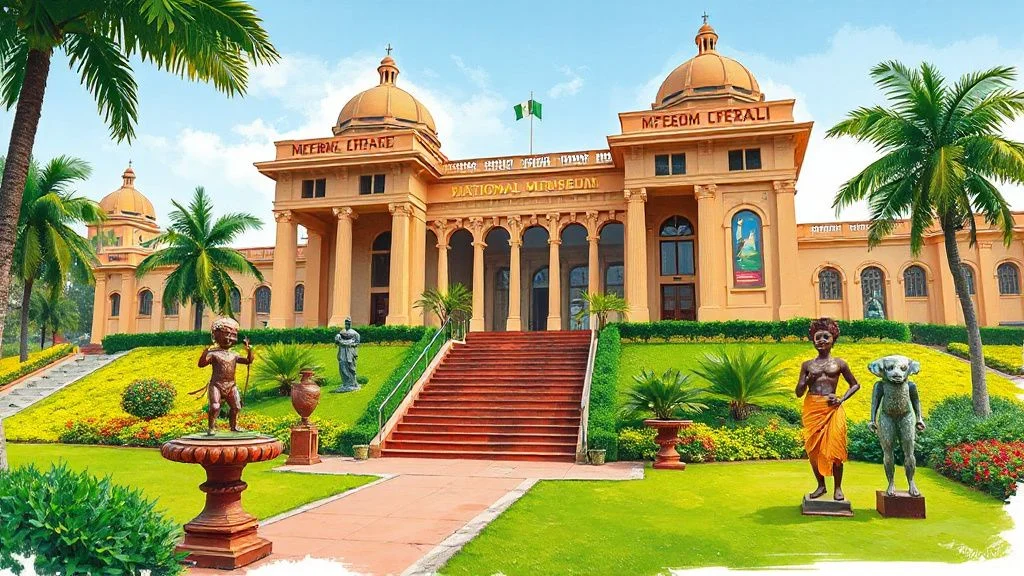
The National Museum Lagos sits in Onikan on Lagos Island and is the obvious first stop for anyone wanting a sense of Nigerian history in an afternoon. This guide names what is in it, where the facts come from, and which commonly repeated details are weaker than they look.
What can we help you with?
Three short questions, then just how to reach you. No account needed.
Founding and who runs it
The museum was founded in 1957 by the English archaeologist Kenneth Murray, and it is administered by the National Commission for Museums and Monuments. It stands at Onikan, Lagos Island, in Lagos State.
What is in the collection
The collection is "estimated at 47,000 objects" — the word estimated is the encyclopedia's own, and the figure traces to newspaper reporting from 2019 rather than to a museum inventory, so treat it as an order of magnitude. The objects are made of "wood, ivory, metal and terracotta".
Two holdings are worth going for specifically:
- The Jemaa Head, a terracotta human head of the Nok culture, dated c. 900 to 200 BC. The "c." is in the source; Nok dating is genuinely uncertain and different publications give different ranges. This is the single most famous object in the building.
- Igbo-Ukwu bronze artifacts, from the Igbo-Ukwu finds in southeastern Nigeria.
Alongside these the museum holds further Nok terracottas, and its collection spans the regional cultures of Nigeria rather than concentrating on one.
The exhibit everyone mentions, and how firm it is
The museum is widely said to display the car in which General Murtala Mohammed was assassinated in 1976, and it is the detail most guides lead with. Being straight about the evidence: in the encyclopedia entry this appears only as a photo gallery caption, with no citation and no mention in the body text. It is very likely there and has been reported by travel publications, but it is not confirmed here to the standard of the founding date or the Nok material. If it is the reason you are going, ask the museum before you travel.
What this guide does not publish
No opening hours and no admission price. The source used here carries neither, and museum hours and ticket prices are exactly the sort of detail that changes without any guide noticing. Check with the museum or the National Commission for Museums and Monuments on the day you plan to go.
No room-by-room layout. Describing exhibits as "organized into thematic sections" tells a visitor nothing, and inventing a floor plan would be worse. The named objects above are what can be stated.
Practical notes
- Onikan is central Lagos Island, which means traffic rather than distance decides your journey time. Going mid-morning on a weekday is a different trip from the same distance at five in the afternoon.
- A guide inside is worth it for a collection of this range, particularly for the Nok and Igbo-Ukwu material, where the context is most of the interest.
- Combine it with the area. Onikan places you within walking distance of other Lagos Island landmarks, so the museum works better as part of an afternoon than as a single errand.
- Ask about photography on arrival rather than assuming either way.
Where to check
The founding, administration, collection size and named objects above are from the entry on the Nigerian National Museum, read on 23 October 2026, with the strength of each claim noted where the source itself is thin. For hours, admission and current exhibitions, the museum and the National Commission for Museums and Monuments are the authorities.
AI-Generated Content: This article was created with AI assistance and may contain inaccuracies. Please verify important information with official sources.