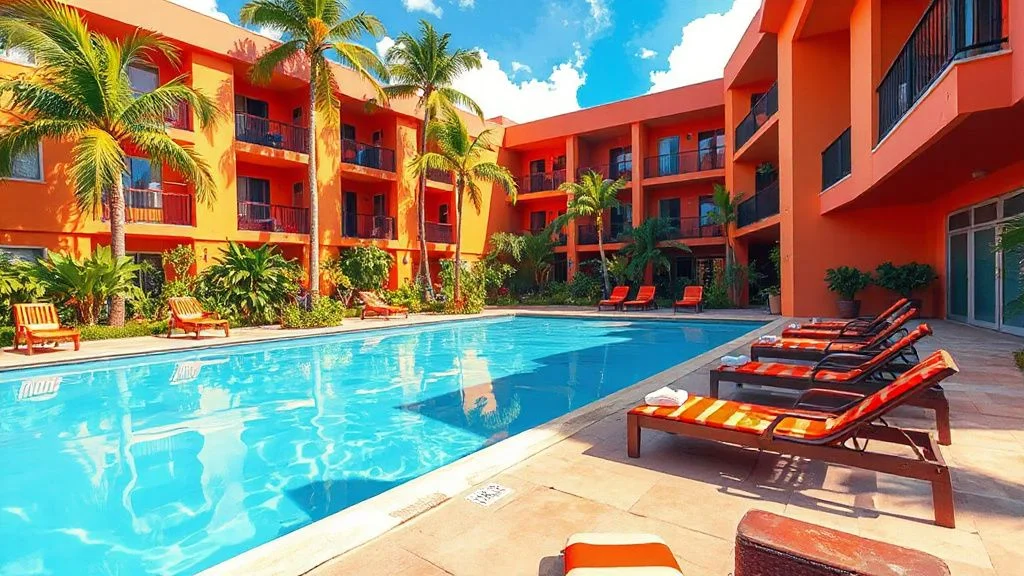
A hotel day pass is a recognizable product: access to a hotel's pool and leisure facilities for a day, sold to somebody who is not staying overnight. Whether a particular hotel in Nigeria sells one, what it costs, what it includes and who may use it are questions for that hotel, and this article is not going to answer them for you with figures nobody published. What it will do is set out the two things that are on the public record, and then give you the list of questions that gets the rest answered by the only party who can answer it.
What can we help you with?
Three short questions, then just how to reach you. No account needed.
Why this article names no hotel and quotes no price
An earlier version of this page described four properties without naming them and then stated their terms as fact: what the pass included, whether children were catered for, whether food and drink came at a discount, how many passes were sold in a day. Every one of those statements is a commercial claim about a real, identifiable business, and not one of them came from the business.
We looked for the source. We could not find a single hotel in Nigeria that publishes its day-pass terms on a page we could read and date. Rates and conditions of this kind are typically quoted by phone, at the desk, or through a booking platform that is not the hotel. That makes every number in circulation a number with no publisher behind it, and it is why the terms below appear as questions rather than as answers.
The tax that sits on your bill in Lagos
If your day pass is in Lagos and anything is consumed on the premises, a state tax applies to it. The Lagos State Internal Revenue Service publishes the rule under the Hotel Occupancy and Restaurant Consumption Law. Read on 24 October 2026, the service's own guidance states:
- The law imposes Tax on goods and services consumed in Hotels, Facility or Event Centres in Lagos State.
- The rate of tax imposed by the law is 5% of the bill.
- That 5 percent is calculated on the amount excluding Value Added Tax and Service Charge.
- The business supplying the goods or services shall collect this for and on behalf of the State and remit it to a designated state revenue bank.
- Tax collected in a month is due on or before the 20th day of the following month.
One honest caution about that source. This law has been litigated for years, with hotel operators challenging it and courts ruling in both directions on enforcement. The rate and the mechanism above are what the revenue service publishes today; the question of what is currently enforceable is a legal question we are not in a position to settle. Treat it as the reason to ask whether a quoted price is inclusive, not as a calculation to run yourself.
Where to check that a hotel is what it says it is
Instead of a star rating in an advertisement, there is a federal register. The Nigerian Tourism Development Authority runs an online accreditation portal and describes its accreditation program as the foundation of the National Classification and Grading Scheme. Accredited businesses are listed in what the portal calls the National Hospitality Directory, and the portal carries a public search. If a property's grade matters to you, that directory is the place to look it up rather than the property's own marketing.
Two limits worth knowing. The portal does not publish the terms on which any establishment sells access to its facilities, so accreditation tells you nothing about a day pass. And responsibility for registering and grading hotels has been contested between the federal authority and individual states for years, so a property may appear in one register and not another.
The questions to ask before you cross a city for a swim
Ask the hotel directly, and ask for the answer in writing or by message rather than over the phone. These are the questions whose answers were previously asserted here without a source:
- Is a day pass sold at all to someone not staying at the hotel, and on which days of the week?
- What are the hours? Does access end at a set time, and is there a separate closing time for the pool itself?
- What does the price cover? Pool only, or also gym, sauna, loungers, towels and parking?
- Is there a minimum spend on food or drink instead of, or on top of, the pass?
- Is the quoted amount inclusive of Value Added Tax, of any service charge, and of the Lagos consumption tax where that applies?
- Are children admitted, at what ages, at what price, and must an adult stay in the water with them?
- Is there a cap on the number of non-guests admitted in a day, and can the pass be reserved in advance?
- Is the pool ever closed to non-guests for private events, and what happens to a booking if it is?
- Is there a dress code for the pool deck and for moving through the rest of the property?
- What are the supervision arrangements? Is a lifeguard on duty during the hours you plan to be there?
The last of those is the one we would not take on trust from any secondary source. Nothing we could read sets a published national requirement for lifeguard cover at a hotel pool, so the only answer that means anything is the hotel's own.
What we could not establish
- Any price. No hotel day-pass rate in Nigeria is published in a form we could cite, so no amount appears in this article.
- Any hotel's terms. Opening hours, inclusions, children's admission, minimum spend and capacity limits are all unpublished, for every property we looked for.
- Whether the Lagos consumption tax is currently enforced. The revenue service publishes the rule; the litigation history means its present application is a question for a Nigerian tax adviser.
- Any national standard for pool safety or water quality at hotels. We found none published.
What expats should know
- A day pass is a product, not a published tariff. Treat every figure you see quoted online as unsourced until the hotel confirms it.
- In Lagos, ask whether the price is inclusive. The published rate of the state consumption tax is 5 percent of the bill, excluding Value Added Tax and service charge.
- Use the federal register, not the advertisement, to check a property's accreditation and grade.
- Get the answer in writing. Hours, inclusions and children's admission change without notice and a phone call leaves you nothing to point at.
- Ask about lifeguard cover explicitly if you are bringing children. It is not answered by any source we could find.
Where to check
The consumption tax rate, the exclusion of Value Added Tax and service charge, the collection duty and the twentieth-of-the-month deadline are from the Lagos State Internal Revenue Service's own published questions and answers, read on 24 October 2026. The accreditation scheme, the National Hospitality Directory and the public search are from the Nigerian Tourism Development Authority's accreditation portal, read on the same date. Everything else in this article is a question, because everything else is unpublished.
AI-Generated Content: This article was created with AI assistance and may contain inaccuracies. Please verify important information with official sources.