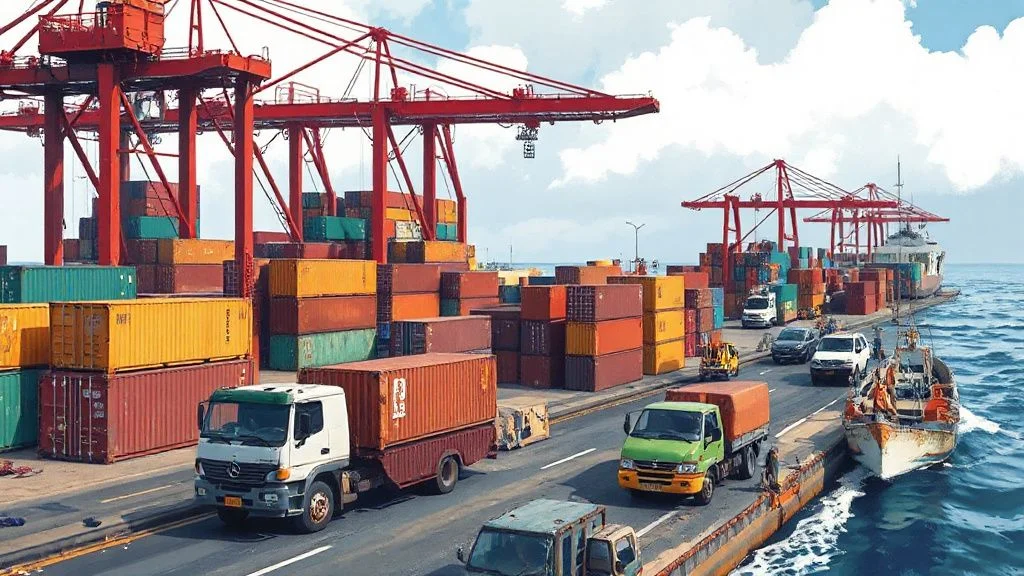
Clearing a used vehicle in Nigeria is a stack of separate charges applied to the customs value, not a single duty. The individual rates are well reported; one of them changed in mid-2026, and several figures in circulation predate that change. This article sets out the stack, flags which figures are officially published and which are not, and explains why the only number that matters is the one your clearing agent produces for your specific vehicle.
What can we help you with?
Three short questions, then just how to reach you. No account needed.
The stack
Charges are applied to the CIF value — cost, insurance and freight — as assessed by the Nigeria Customs Service, not to what you paid for the car. The components reported across clearing and logistics sources are:
- Import duty: 20% of CIF for used passenger vehicles. This is the most consistently reported figure and sits within the ECOWAS common external tariff framework.
- National Automotive Council levy. Reported at 15% of CIF historically, and reduced to 5% for used vehicles with effect from 1 July 2026 under what multiple sources describe as the 2026 Fiscal Policy Measures, with the levy on new vehicles reported as falling from 20% to 10%.
- VAT at 7.5%.
- A surcharge of 7%, applied on the duty rather than on the CIF value.
- ETLS levy of 0.5% — the ECOWAS Trade Liberalisation Scheme levy.
- Some sources additionally report a 4% FOB levy and a green tax graduated by engine size.
A caution that matters. None of these figures appears in an official Nigeria Customs Service or National Automotive Council publication that could be verified for this article. They are consistently reported by clearing agents, logistics firms and duty calculators, and the 20% duty and 7.5% VAT are stable across all of them — but the levy reduction of July 2026 is reported only by secondary sources. Confirm the current rates with the Nigeria Customs Service or a licensed clearing agent before you ship anything.
What the stack comes to
Because the components apply to different bases, the all-in figure is not the sum of the percentages. Sources that work it through land in a range of roughly 35% to 45% of CIF value before port and agent charges, with one guide putting a car under 2,000cc at roughly 37% to 40%.
Treat that range as an indication of magnitude rather than a quote. Three things move it materially:
Which levy rate applies. The difference between a 15% and a 5% NAC levy is ten percentage points of CIF — on its own the largest single variable in the calculation, and the reason the July 2026 change matters so much to anyone importing now.
The customs value. Duty is assessed on the value Customs puts on the vehicle, which is derived from its own valuation data rather than from your purchase invoice. A cheap purchase does not produce a cheap clearance.
Engine size and age. Where a green tax by engine capacity applies, a larger engine costs more, and vehicle age limits apply to imports independently of the duty.
What is not part of the duty
Two categories of cost get folded into "clearing costs" and are not taxes at all.
Port and terminal charges — shipping line charges, terminal handling, demurrage if the vehicle sits. Demurrage is the one that bites: it accrues daily while paperwork is resolved, which makes a complete file worth real money.
Agent's fees. A licensed clearing agent's charge for handling the clearance.
Neither appears in a duty calculator, and together they can add meaningfully to the landed cost.
Figures to be careful with
Three kinds of number should be treated sceptically when you meet them in a guide.
Pre-July-2026 levy rates. Any calculation using a 15% NAC levy for a used vehicle may be describing the position before the reported reduction. Check the date of the guidance.
Costs quoted in another currency for another country's process. A documentation or handling charge quoted in pounds sterling by a United Kingdom forwarder is a cost of exporting from the United Kingdom, not a Nigerian import charge. It does not belong in a Nigerian duty calculation.
Prices from foreign used-car marketplaces. A vehicle's price on a Chinese or American sales platform tells you nothing about its Nigerian customs value, and using it as the base produces a figure that will not match the assessment.
Getting a figure you can rely on
- Get the vehicle's details exactly: make, model, year, engine capacity, and the VIN.
- Ask a licensed clearing agent for a written estimate covering duty, levy, VAT, surcharge, ETLS and any green tax, plus port charges and the agent's fee.
- Ask which levy rate they are applying and on what authority. If they quote 15% for a used vehicle after July 2026, ask them to confirm against the current measures.
- Confirm the vehicle meets the age limit for import before you buy it.
- Budget demurrage as a contingency, and have the documents ready before the vehicle lands.
- Keep every receipt. The duty assessment and the evidence of payment are what establish the vehicle was lawfully cleared.
Is importing worth it at all?
Work the comparison honestly before you commit. At roughly 35% to 45% of CIF in taxes and levies, plus shipping, port charges and an agent's fee, the landed cost of a used vehicle can approach or exceed the price of an equivalent vehicle already in Nigeria. The arguments for importing are specification, condition and provenance; the argument against is cost and the risk of the process. Price a comparable local purchase before you ship.
What expats should know
Four points. The charge is a stack applied to the customs value, not your purchase price: 20% duty, a NAC levy reported as reduced to 5% for used vehicles from 1 July 2026, VAT at 7.5%, a 7% surcharge on the duty and a 0.5% ETLS levy, landing in the region of 35% to 45% of CIF in total. None of those rates could be verified here against an official Customs or NAC publication, so confirm them before shipping. Port charges, demurrage and the agent's fee sit on top and are not taxes. And ignore figures denominated for another country's export process or taken from a foreign sales platform — they are not inputs to a Nigerian clearance.
Primary Sources
Last updated: November 2026