Rainwater harvesting is a technical subject, which makes it unusually easy to write badly: the shape of the sentences stays the same whether the numbers in them are measured or invented. The version of this page that was held had the shape right and the substance missing. This one keeps the engineering decisions and drops everything that was never measured.
What can we help you with?
Three short questions, then just how to reach you. No account needed.
What this article does not tell you
Four quantities are absent on purpose, and their absence is the point.
- No millimeters of rainfall. Not for Lagos, not for Abuja, not for a season. Our approved reference data holds no rainfall figure for Nigeria at all — that was checked, not assumed — and a depth of rain is the input every other number in a harvesting calculation depends on.
- No tank sizes. A capacity in liters or cubic meters is the output of a calculation we cannot run without the rainfall and your roof area.
- No prices and no payback period. The held version said the investment can often be recouped through savings. We have no installed cost, no water delivery price and no borehole cost for Nigeria that we can source and date, so there is no arithmetic here and no promise of one.
- No claim about how much of your supply this replaces. That follows from the rainfall and the tank, so it shares their fate.
What survives is the part a household actually decides: the parts of a system, the order of the decisions, the questions to put to an installer, and — on the one subject where a guide must not improvise — what a health authority says about drinking it.
The parts, and what each one is for
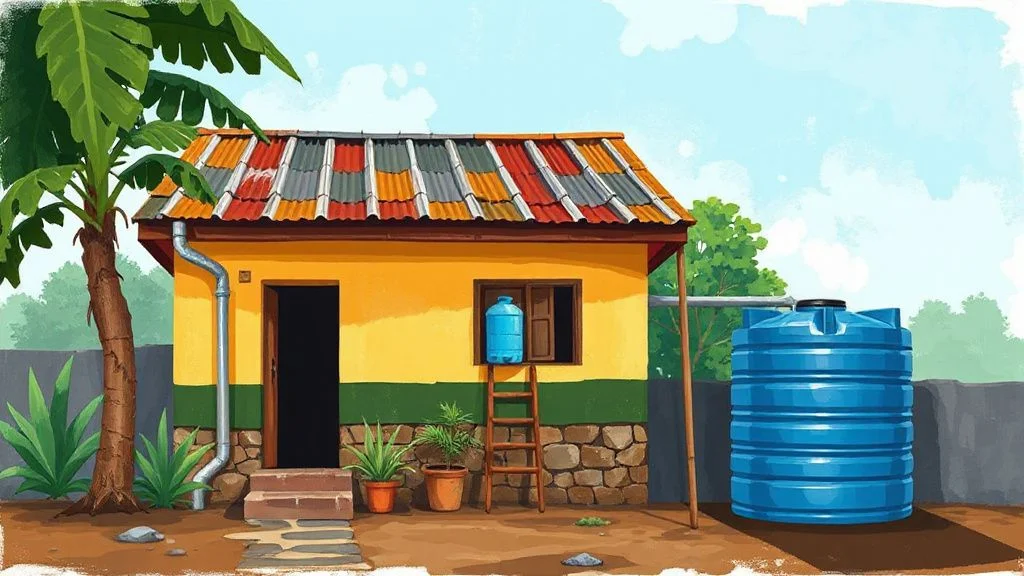
A domestic system is four things in series, and naming them correctly is most of what you need to talk to an installer.
- A catchment, almost always the roof. Its material and its condition decide what ends up in the water, which is a quality question before it is a volume question.
- A conveyance: gutters, downpipes and the brackets that hold them. This is the part that is undersized or badly fixed most often, and the part that a heavy roof load finds first.
- Storage: one or more tanks, above or below ground, in plastic or concrete. Covered and screened, because an open tank is a different thing from a closed one both for mosquitoes and for contamination.
- Treatment, if the water is going anywhere near a mouth: screening and settling at minimum, then filtration, and then whatever the intended use requires. See the next two sections before deciding what this step has to achieve.
Systems are often described as passive or active. The distinction is simply whether the water moves by gravity alone or whether a pump and powered treatment are involved; it is a description of the plumbing, not a grade of quality. A passive system with a clean catchment can be better water than an active one with a neglected filter.
Drinking it: the part that must come from an authority
Because this is drinking water, the quality statements on this page come from a public health authority and nowhere else. The U.S. Centers for Disease Control and Prevention publishes a page on collecting rainwater, dated 23 July 2024, which we read on 24 October 2026. In its own words:
- Rainwater is not necessarily safe to drink without first removing germs and chemicals from it
- Even when rainwater looks clean, it can contain germs and chemicals that could make you sick
- Regularly test your rainwater for germs and chemicals if you drink, cook, or bathe with it
- Consider only using rainwater in ways that limit the chances you will swallow it
- rainwater you drink needs to be cleaner (higher quality) than rainwater you use to water flowers
That agency also names the roof and gutters themselves as a source of contamination — asbestos, lead or copper from roofing materials, and dirt and germs washed off the surface — and says that maintaining the system is what keeps them out. Note two limits on using it here, stated plainly: this is an American agency and not a Nigerian one, and its guidance is general to roof-collected rainwater rather than specific to any Nigerian city. It is cited because the physics of a dirty roof does not change at a border, and because the alternative was a guide's opinion about drinking water.
The World Health Organization also publishes on this. Its Guidelines for drinking-water quality are the international reference, and the second addendum to volume 1 of the third edition, published in 2008, added guidance specifically on household water management, rainwater harvesting. The current edition is the fourth. If you intend to drink what you collect, that is the document to put in front of whoever designs the treatment.
Nigeria's own standard, and what we could not confirm
Nigeria has a national drinking water standard: NIS 554, the Nigerian Standard for Drinking Water Quality, issued by the Standards Organisation of Nigeria and approved by its Governing Council in April 2007. It sets parameters and maximum allowable limits for drinking water and addresses monitoring and compliance.
Here is what we could not establish, and we are not going to paper over it. We could not confirm from the Standards Organisation's own website which revision of NIS 554 is currently in force — the pages we could read on 24 October 2026 do not mention it, and the third-party databases that give a revision year contradict each other. Nor could we establish whether the standard addresses privately harvested rainwater at a household at all, as opposed to water agencies, community systems and vendors. So: do not let anyone tell you your tank water meets NIS 554 without showing you a laboratory result against a named revision of the standard. Ask the Organisation directly for the current edition, and ask your installer which revision their test report was measured against.
Permission and rules: a second gap, named
The held version advised readers to check local regulations regarding rainwater harvesting and implied there might be incentives. We went looking. In Lagos, water abstraction, distribution and supply are regulated by the Lagos State Water Regulatory Commission, established under state law and supervised by the state environment and water resources ministry; its remit is usually described in terms of boreholes, abstraction and supply rather than roof catchment. We could not read its site: it returned a server error 522 on 24 October 2026.
We therefore found no published Nigerian rule, permit requirement or incentive specifically for household rainwater harvesting, and we are not going to invent one in either direction — neither a permit you do not need nor a freedom you may not have. Put the question to the state water regulator and to your local planning authority in writing before you install, and ask it as two separate questions: does collecting roof water require anything of me, and does discharging the overflow require anything of me.
Sizing: the questions instead of the numbers
Since we will not give you a tank size, here is what determines one, so you can recognize an installer who is calculating rather than guessing. A serious proposal will have asked, and written down, all of the following:
- Your roof's collecting area in square meters — the plan area, not the sloped surface — and its material.
- A rainfall record for your location, by month, from a named meteorological source, and how many years it covers.
- The length of the dry period the tank is supposed to carry you through, as an explicit assumption rather than a feeling.
- Your household's daily demand, split by use, because the volume for flushing and the garden is a different quality problem from the volume for the kitchen.
- What happens when the tank is full — where the overflow goes, and whether that place can take it in the heaviest week of the year.
- What happens when the tank is empty — which supply you fall back on, and whether the switch is manual.
If a quotation arrives with a capacity on it and none of those six written down, the capacity came from a catalog, not from your roof. That is the single most useful thing in this article.
Maintenance, and what expats should know
A harvesting system is not an appliance; it is a small piece of water infrastructure with a maintenance schedule, and its output quality depends on that schedule more than on its specification. Clear gutters and screens of leaves and debris, keep the tank covered and inspect it for sediment, keep the first flush of a storm out of the tank if the system has a diverter, and have the water tested on the schedule the health authority recommends if anyone drinks, cooks or bathes with it. Put the testing in the calendar at installation, because it is the step that quietly stops happening.
- No rainfall figures, tank sizes, costs or payback periods appear here, because we have no sourced Nigerian values for them.
- Treat collected rainwater as unsafe to drink until it is treated and tested. That is the health authority's position, not ours.
- The roof and gutters are part of the water quality, not just the plumbing.
- NIS 554 exists; which revision applies, we could not confirm. Ask for a lab result against a named revision.
- No Nigerian rule on household harvesting could be found, and the Lagos regulator's site was unreachable on 24 October 2026. Ask in writing.
- Judge a quotation by the six inputs above, not by the tank size on the front page.
Sources, read on 24 October 2026: the U.S. Centers for Disease Control and Prevention page on collecting rainwater, dated 23 July 2024; the World Health Organization's second addendum to volume 1 of the third edition of the Guidelines for drinking-water quality (2008), which added the rainwater harvesting guidance, and the fourth edition; and the Standards Organisation of Nigeria, for NIS 554 and its current revision.
AI-Generated Content: This article was created with AI assistance and may contain inaccuracies. Please verify important information with official sources.