
Before any of the rest of this: Nigeria's heritage commission publishes no admission fee for any of its museums, and publishes one single set of gallery hours for all of them. Guides that give you a price at the door and a per-museum timetable are not quoting a source. This article gives you what the National Commission for Museums and Monuments actually publishes, which is enough to plan a trip and not enough to promise you an open door.
What can we help you with?
Three short questions, then just how to reach you. No account needed.
Standing instruction for every place named below: telephone the museum, or the commission, and confirm the opening hours for the day you intend to go, before you travel. We name only institutions that appear on the commission's own published lists, and even for those we cannot tell you that they will be open.
What the commission publishes, and what it does not
The National Commission for Museums and Monuments is the federal agency that runs Nigeria's national museums and declares its monuments. Its history page dates the institution precisely: the Nigerian Antiquity Service was inaugurated on 28 July 1943, with K. C. Murray as its first director; the Antiquities Ordinance No. 17 followed in 1953; and Decree No. 77 of 1979 dissolved the Antiquities Commission and put the present commission in its place.
Two things are not on those pages, and a lot of writing about Nigerian museums assumes they are. There is no founding year published for the museum in Lagos. The only time 1957 appears on the commission's history page is in the table of past directors, as the start of B. E. D. Fagg's term as Surveyor of Antiquities, 1957 to 1963. That is a person's appointment, not a building's opening. And there is no admission fee anywhere. Not on the museums list, not on the commission's own frequently asked questions. We are not going to invent one.
The museums on the commission's own list
The published list describes the commission as managing fifty-three Museums and outlets spread across the country, and then names forty-nine of them. That gap is the commission's own; we are reporting it rather than resolving it. The addresses, exactly as the list gives them, include:
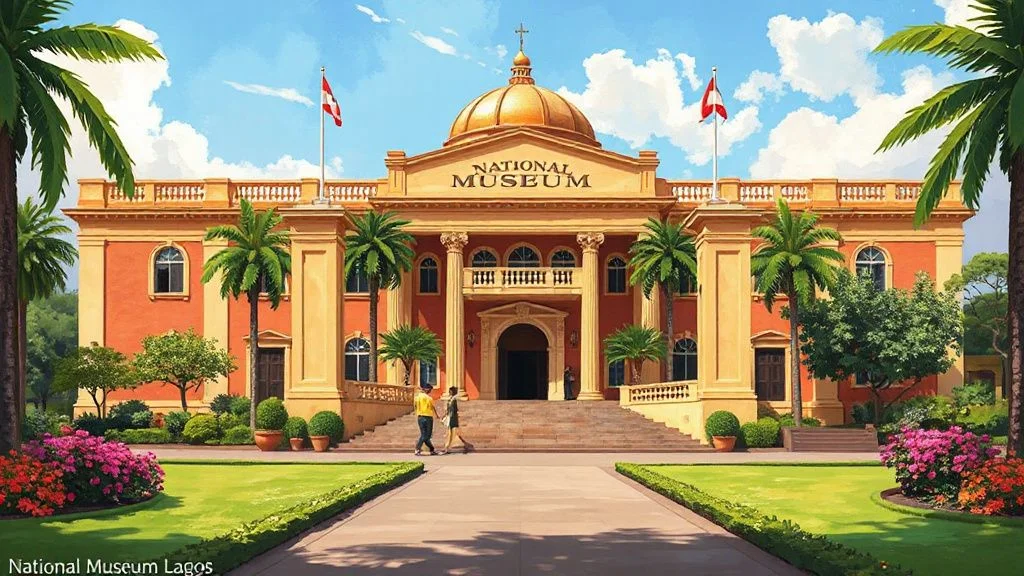
- National Museum Lagos — King George V. Road, Onikan, P.M.B. 12556, Lagos State.
- National Museum Kano — Opposite Emir's Palace, Kano city, P.M.B. 2023, Kano State.
- National Museum Benin — Ring Road, Benin City P.M.B. 1115, Benin City Edo State
- National Museum of Colonial History, Lokoja — P.M.B. 1022, Lokoja, Kogi State.
- Museum of Traditional Nigerian Architecture (MOTNA), Jos — Opposite High Court P.M.B. 2931, Jos Plateau State
- National Museum Asaba — Mungo Park House P.M.B. 95071, Asaba, Delta State.
- Interpretation Centre, Sukur — Mubi-Maidugur Road, Sukur, P.M.B. 06, Madegali Local Government, Adamawa State.
Note the fourth entry. If your interest is the colonial period specifically, the commission runs a museum devoted to it — the National Museum of Colonial History in Lokoja, the old administrative center on the Niger. It is the most obviously relevant institution in the country for this subject and it is missing from most guides, including the earlier version of this one.
Note also the name in Kano. The building is widely called Gidan Makama, and the commission's own page carries a photograph captioned that way, but the listed institution is National Museum Kano. Ask for it by the listed name if you are telephoning ahead.
The Abuja museum that is not on the list
This one matters because it is the sort of error that puts somebody in a taxi for nothing. There is no national museum in Abuja on the commission's list of National Museums. The only Abuja address on the page is the commission's own office — Block C, First Floor, Federal Secretariat, Abuja, Nigeria. That is an administrative headquarters, not a gallery with exhibits and a timetable.
There is also no museum in Calabar and none in Badagry on that list, although, as the next section shows, Calabar does hold two declared national monuments. If a guide sends you to a national museum in one of those three cities, it is not working from the commission's list. Confirm before you build a day around it.
One set of gallery hours — and no fee at all
The commission publishes general gallery hours for its National Museums, as one block, not per museum: Monday to Friday 9:00 to 16:00, Saturday 9:00 to 16:00, and Sunday 11:00 to 16:00. The Sunday line is published as Sunday: 11:00 – 16:00, which is worth holding on to, because a claim that the galleries shut on Sunday is a common one and it is not what the commission publishes.
Read those hours for what they are: a general statement for a network of forty-nine or more locations, several of which sit inside a palace compound, a federal secretariat or a local government building with its own access rules. They are not a guarantee for any single address, and the commission does not publish an exception list. So you still telephone first, and you ask three things: is the gallery open on that date, is there a charge, and is there a separate photography permit.
On the charge: no admission fee is published by the commission for any museum, in any amount, in any currency. Figures circulate for the door at Lagos, Kano and Benin City. None of them is sourced to the commission, and we have removed the ones that were in this article. Ask at the desk, or on the telephone, and budget for the possibility of a fee rather than for a number.
The declared colonial-era monuments
Alongside the museums the commission manages and oversees sixty-five National monuments, and heritage sites spread across the country, with further sites it describes as awaiting legislative declaration. Several of the sixty-five are colonial-era structures in the plainest sense, and these are the ones to look up if the architecture rather than the collection is what you want. Named and located exactly as the commission writes them:
- The Old Residency, Calabar, Cross Rivers State
- The Old Consulate, Calabar, Cross Rivers State
- Steel foot Bridge, Built by Lord Lugard, Kaduna State
- Old West African Frontier Force Fort at Okuta, Kwara State
- Old West African Frontier Force Fort at Yashikera, Kwara State
- Ruins and Site of colonial Government House at Zungeru, Niger State
The spelling Cross Rivers State is the commission's, not ours; the state is Cross River. A declared monument is not the same thing as a staffed visitor attraction: declaration is a legal status, and the commission publishes no hours, no fee and no access arrangement for any of these six. Treat each as a site you arrange access to in advance, locally, and not as somewhere you turn up.
For completeness on the UNESCO question, which comes up constantly in this context: the commission's world heritage page lists two inscribed Nigerian sites — the Sukur Cultural Landscape in Madagali, Adamawa State, Declared a UNESCO World Heritage Site in November 1999, and the river-side shrine and sacred grove of Osun at Osogbo, enlisted into the prestigious UNESCO World Heritage list on 15th July 2005. Two. Any third Nigerian site described to you as world heritage is almost certainly on the tentative list instead, which is a different thing.
The Benin objects that came back, and why two numbers circulate
If you are reading about colonial-era collections you will meet the objects taken from the Kingdom of Benin in 1897, and you will meet two different counts of a recent Dutch return. Both are right, and here is why.
The Dutch Ministry of Education, Culture and Science published the return on 19 February 2025. It returned 113 objects from the national collection — the Rijkscollectie — and, separately, six from the municipality of Rotterdam. That is where 113 and 119 both come from. The transfer agreement was signed that day at the Wereldmuseum in Leiden by the Dutch minister, Eppo Bruins, and by Olugbile Holloway, Director-General of the National Commission for Museums and Monuments. On the origin the ministry is blunt: In 1897 hebben Britse soldaten deze objecten geroofd uit het Koninkrijk Benin — in 1897 British soldiers looted these objects from the Kingdom of Benin.
What that release does not say is where any of it is now on display. So we are not telling you to go to a particular gallery to see it. Ask the commission which of the returned objects is accessible, and where, before you plan a journey around them.
One tool does help here. The commission runs a public catalogue of its collection, searchable by object with filters for culture, region, material and period. Its limitation is exactly the one that matters to a visitor: it has no filter for which museum holds an object, and does not reliably state the holding museum. It will tell you that something is in the national collection. It will not tell you that it is in the case in front of you.
What expats should know
- No admission fee is published for any national museum. Every figure you have read for the door at Lagos, Kano or Benin City is unsourced.
- There is one published set of gallery hours, not one per museum — including Sunday 11:00 to 16:00, which contradicts the usual claim of a Sunday closure.
- Telephone and confirm the hours for your date, for every site, before travelling. The general hours cover forty-nine-plus locations and guarantee none of them.
- There is no national museum in Abuja on the commission's list, nor one in Calabar or Badagry.
- For the colonial period specifically, the relevant institution is the National Museum of Colonial History in Lokoja.
- The Kano institution is listed as National Museum Kano, whatever the building is called.
- No founding year is published for the Lagos museum. The 1957 that circulates is a director's start date.
- Nigeria has two inscribed UNESCO World Heritage Sites, Sukur and the Osun grove at Osogbo — not three, and not a national park.
- 113 plus 6 is the answer to the Benin count: 113 from the Dutch national collection, six from Rotterdam, agreement signed 19 February 2025.
- A declared monument is a legal status, not an opening time. Arrange access to the six colonial-era monuments in advance.
Where to check
The museum names, addresses, general gallery hours and the fifty-three figure are from the commission's National Museums page. The monuments and their spellings are from its list of national monuments; the two inscribed sites from its world heritage sites page; the 1943, 1953 and 1979 dates and the Fagg term from its history page; and the object catalogue is at the commission's collection site. All read on 24 October 2026. The Benin figures, the signing and the 1897 sentence are from the Dutch Ministry of Education, Culture and Science's release of 19 February 2025. No admission fee and no per-museum timetable was found at any of them; where this article gives you no number, that is because nobody published one.
AI-Generated Content: This article was created with AI assistance and may contain inaccuracies. Please verify important information with official sources.
Primary Sources
Last updated: October 2026
