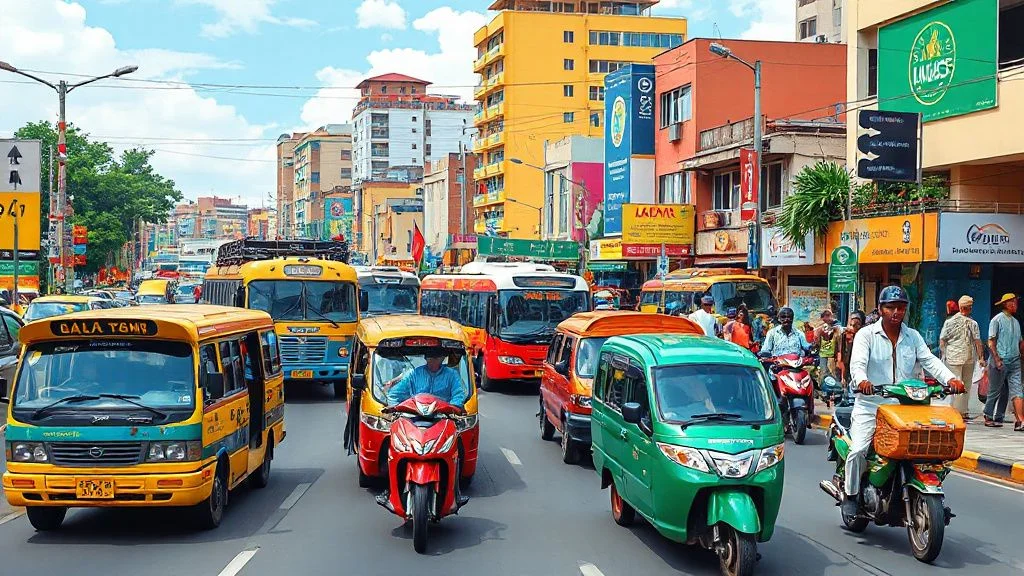
If you want to know whether Lagos public transport is reliable enough to commute on daily, you want a punctuality figure. Nobody publishes one. Not the Lagos Metropolitan Area Transport Authority, not the National Bureau of Statistics. So this article does something more useful than guess: it sets out exactly what the authority does publish, and names every gap where a number would have gone.
What can we help you with?
Three short questions, then just how to reach you. No account needed.
What "reliable enough" would mean, and why no one publishes it
Reliability is on-time performance: the share of services that arrive within some stated margin of the timetable. That is the number transit authorities elsewhere publish monthly, and the one Lagos does not. LAMATA publishes no on-time performance figure, no journey time for any corridor, and no service-interval commitment for its bus network.
We are also not going to manufacture one. The authority's bus pages carry an average operating speed, and dividing a corridor length by it would produce a plausible-looking commute time on an undated page. That would be a guess wearing an official source, and it is exactly the kind of figure that sends people into a tenancy on the wrong side of the city.
The Blue Line: Lagos's one published timetable
There is one genuine exception, and if you are choosing where to live it may be the most important published document in the city. LAMATA publishes a Blue Line rail schedule, read on 24 October 2026:
- 102 trips daily, 51 trains in each direction.
- Monday to Saturday. No Sunday service is listed.
- Marina towards Mile 2: first departure 05:30, last 21:50.
- Mile 2 towards Marina: first departure 05:40, last 21:52.
- Headway of 8 to 12 minutes during peak periods.
- Five stations: Marina, National Theatre, Iganmu, Alaba, Mile 2.
A trip count, a service span and a peak headway are real planning inputs. What they are not is a reliability measure: a published headway says how often a train is scheduled, not how often one comes. And note the dating — the schedule page is marked UPDATED with no date attached, so confirm it before you sign a lease on the strength of it.
The rail network on paper versus the segment that runs
Be careful not to read the plan as the service. LAMATA describes the Blue Line as a 27 km railroad with thirteen stations from Okokomaiko to Marina. The timetable above covers five stations between Marina and Mile 2. The difference between thirteen and five is the difference between the project and your commute.
The Red Line is published as a north-south line proposed from Agbado to Marina, in two phases. The authority's own page lists its stations inconsistently — one list of twelve proposed stations, another of ten, with a station present in one and absent from the other — and gives no timetable, no fare and no operating days. Treat it as a plan.
The BRT corridor, and the age of its published numbers
The Bus Rapid Transit story on LAMATA's own pages is a 22 km Mile 12 to CMS "BRT Lite" pilot, published as commissioned on 17 March 2008, running 220 buses, with an intention to implement BRT along eight different corridors within the metropolis and operating hours of 06:00 to 22:00.
Now the dating problem, stated plainly because it changes how you should read all of it: the page carries no date, and its own two ridership figures disagree with each other — one sentence says more than 200,000 passengers daily and the performance section gives an average of 180,000. It also names the same corridor two different ways. We are therefore using none of those figures as facts about today's network, only as evidence that the published material has not been maintained. If you need the current corridor list, ask LAMATA for it.
Fares: the authority's own table does not load
LAMATA does publish bus fares, and we could not read them. Its fare page is labeled BRI Fares: 1 MAR 2026 and 80 routes, which tells you a dated fare schedule exists — but the table itself is loaded by script and renders as zero routes, measured on 24 October 2026.
So we are giving you no Lagos bus fare and no rail fare. Figures circulate; the ones we saw disagreed with each other and came from guides, not from LAMATA. Since a dated schedule demonstrably exists, the right move is to ask LAMATA's customer service for the 1 March 2026 fare table by route, or read it at a station. Also ask which payment card is required, because a cash fare and a card fare are not always the same thing.
What the national fare statistics do and do not say about Lagos
The National Bureau of Statistics publishes a monthly Transport Fare Watch. For May 2026 it gives:
- NGN 1,431.25 for a bus journey within a city, per drop
- NGN 1,072.51 for a motorcycle taxi ride, per drop
- NGN 2,276.48 for a waterway passenger journey
- NGN 9,699.55 for an intercity bus journey on a state route
Read the label before the number. These are national averages. The sheet divides Nigeria into six zones rather than states, and Lagos does not appear — the South West zone contains Lagos but also Ibadan and Oyo, so quoting it as a Lagos figure would be a guess. As a sanity check on the national mean, the zone values for the city bus fare ran from NGN 1,334.36 to NGN 1,564.31. The date is the month the sheet names, not the day it was read, and the series is published with a lag of several months. The same office's fuel series does carry a Lagos row; this one does not.
What that gives you is an order of magnitude for a single journey, nationally, several months ago. It is not a Lagos commuting cost and we are not presenting it as one. For danfo minibuses and okada motorcycle taxis there is no published fare table, no route list and no service frequency anywhere — and okada operation is restricted by state and local rules that change, so check the current restrictions for your own area rather than a guide's.
What expats should know
- No punctuality figure exists for any Lagos service. "Reliable enough" cannot be answered with a published number.
- The Blue Line timetable is the one real published schedule: 102 trips, Monday to Saturday, roughly 05:30 to 21:52, 8 to 12 minute peak headway.
- That timetable covers five stations, Marina to Mile 2 — not the thirteen-station line in the project description.
- The schedule page carries no date. Confirm it before committing to an address.
- The BRT pages are visibly unmaintained and contradict themselves on ridership. Ask LAMATA for the current corridors.
- A dated fare schedule exists (1 March 2026) but does not render. Get it from LAMATA or at a station; do not trust a quoted fare.
- National fare averages are national. The NBS sheet leaves Lagos out on purpose.
- Test your own commute before you sign a lease, at the hour you would actually travel, in both directions. No published figure substitutes for that.
Where to check
The rail timetable is LAMATA's Blue Line train schedule; the corridor and network descriptions are its bus services pages; the dated but unrendered fare schedule is its bus fare page. All read on 24 October 2026. The fare averages are from the National Bureau of Statistics' Transport Fare Watch for May 2026, national over six zones. For punctuality, journey times and any Lagos-specific fare, the authority's written answer is the only source there is.
AI-Generated Content: This article was created with AI assistance and may contain inaccuracies. Please verify important information with official sources.
Primary Sources
Last updated: October 2026